Red Jesus Is King Tshirt Design Review
When I pull a new design file into my embroidery software, I am rarely looking at just pixels on a screen. I am visualizing the needle drop, the tension of the thread, and the final texture on the garment. As a designer who has spent years reviewing T-Shirt Designs and evaluating Graphics for real-world application, I look for more than just aesthetic appeal. I look for viability. Does this design hold up in production? Will it translate well from digital to physical? Today, I am putting RED JESUS is KING TSHIRT DESIGN under that same microscope.
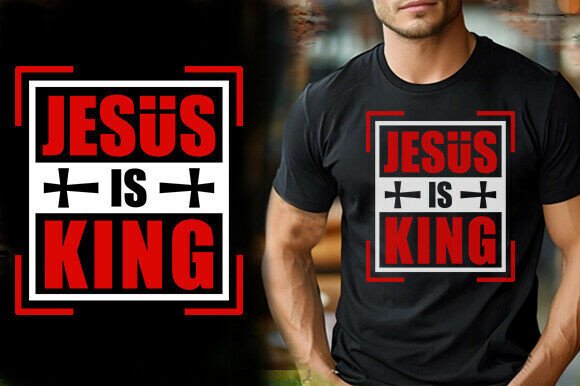
This piece falls squarely into the faith-inspired apparel category, but not all Christian designs are created equal. Some feel generic; others feel heavy-handed. My first impression of RED JESUS is KING TSHIRT DESIGN was one of bold confidence. The layout is straightforward, relying on strong typography and a central iconographic element that commands attention. It does not whisper; it declares. For an embroiderer, this clarity is crucial because embroidery is a tactile medium. Subtle gradients and delicate lines often get lost in the stitch density or blur when stretched across fabric curves. This design avoids those pitfalls by sticking to high-contrast elements that read clearly even from a distance.
The Real-World Test: From Screen to Stitch
To truly judge a design, you have to imagine it on a finished product. Let’s say I am preparing a custom order for a local church youth group or creating a boutique line for an Etsy shop. I decide to use RED JESUS is KING TSHIRT DESIGN on a heavyweight cotton sweatshirt. Why a sweatshirt? Because the structure of the fabric supports heavier stitch areas better than a thin t-shirt jersey, which can pucker or distort under dense fill stitches.
As I map out the placement on the chest area, I consider the visual weight. The design feels balanced, neither too small to be ignored nor so large that it overwhelms the wearer. When stitching, the contrast between the red threads and the dark fabric background becomes the star of the show. If I were to switch to a light-colored tee, the impact would shift dramatically, potentially requiring a different thread palette or an applique base to maintain visibility. This versatility is a key selling point for any embroidery project looking to serve multiple market segments.
I also ran a mental simulation for a baby item, perhaps a christening gown or a layette blanket. Here, the tone shifts slightly. While the message remains powerful, the scale must be adjusted. In this context, RED JESUS is KING TSHIRT DESIGN works beautifully as a sentimental keepsake. Parents appreciate meaningful graphics that offer protection and blessing, making this a strong candidate for personalized gifts. However, I would advise reducing the size significantly to keep the detail soft and approachable for infant wear.
Technical Performance and Stitch Clarity
From a technical standpoint, how does this machine embroidery design behave? The core strength lies in its use of solid shapes and clear lettering. These elements typically utilize fill stitch for the main body and satin stitch for outlines or text borders. This combination ensures durability. A satin stitch edge provides a clean, professional finish that resists fraying, which is essential for items like tote bag design projects or aprons that will undergo frequent washing.
However, no design is without its challenges. I need to address where this design should be used carefully. If you attempt to digitize or embroider this on a curved surface like a baseball cap, the distortion of the text could become problematic. Embroidery machines follow flat planes best; forcing a rigid graphic onto a dome shape requires advanced digitizing skills to compensate for the curve. Similarly, if you plan to use this on a textured fabric like boucle wool or a loose-weave linen, the fine details might disappear into the weave. For these materials, a simpler version of the graphic with fewer tiny details would perform better.
Another critical factor is stitch density. If the original file has overly dense fill areas, it can make the back of the garment stiff and uncomfortable. Before committing to a full production run, always check the density settings. If the design feels too heavy, consider converting some of the fill areas to running stitches or using a cut-applique technique to reduce bulk while maintaining the visual impact. This is especially important for custom apparel intended for daily wear, where comfort is paramount.
Strategic Use Cases for Craft Businesses
For the Etsy seller or small business owner, understanding the right product fit is half the battle. RED JESUS is KING TSHIRT DESIGN is not limited to shirts. Its bold nature makes it excellent for:
- Embroidered Patches: Create iron-on or sew-on patches for denim jackets or backpacks. The strong outline allows for easy cutting and finishing.
- Holiday Embroidery: During Christmas or Easter seasons, this design fits naturally into gift-giving traditions. Think pillow covers or kitchen towels featuring the design alongside seasonal motifs.
- Boutique Branding: Use it as a logo-style element on tote bags or canvas shoppers for religious conferences or retreats.
- Nursery Decor: On a larger scale, such as a quilt or wall hanging, the graphic serves as a focal point for a child’s room.
In each of these scenarios, the design elevates the perceived value of the handmade product. Customers are willing to pay a premium for items that look professionally made and carry meaningful messages. The consistency of the design across different mediums helps build brand recognition, whether a customer sees it on a social media post or holds the physical item in their hands.
Practical Designer Notes for Execution
Before you hit start on your machine, there are several non-negotiable steps to ensure success. First, always test the design on scrap fabric. This is the golden rule of embroidery. You need to see how the thread colors interact with the specific dye lot of your fabric. Red can sometimes appear orange or maroon depending on the lighting and fabric undertones.
Second, inspect the small details. Zoom in on the digital preview. Are there any tiny crossbars or isolated dots that might break during stitching? If so, you may need to adjust the digitizing to connect them or remove them entirely. Third, confirm the hoop size required. If the design is large, ensure your machine has a compatible hoop or consider multi-hooping techniques, though this increases production time.
Don’t forget to check the licensing terms. Even if you purchased the digital embroidery file, verify whether it allows for commercial use. Selling finished products usually requires a commercial license, whereas personal gifts do not. As a responsible creator, protecting your business means respecting intellectual property rights. Also, consider using proper stabilizer. For knit fabrics like t-shirts, a tear-away or cut-away stabilizer is essential to prevent stretching. For woven fabrics, a lighter stabilizer may suffice.
Finally, think about the presentation. When photographing your finished product for your craft business or online store, focus on the texture. Show close-ups of the satin edges and the smoothness of the fills. Good photography combined with a strong design like RED JESUS is KING TSHIRT DESIGN creates a compelling narrative that resonates with buyers. It tells them that you care about quality and detail.
In conclusion, RED JESUS is KING TSHIRT DESIGN is a robust, versatile asset for any embroiderer’s library. It offers a balance of bold messaging and structural simplicity that translates well across various mediums. Whether you are creating a single personalized gift or scaling up a line of commercial embroidery goods, this design provides a reliable foundation for professional results. Just remember to test thoroughly, choose the right fabric, and respect the technical limitations of your equipment. When done correctly, the result is not just a stitched image, but a statement piece that stands the test of time.